


Views: 25 Author: Site Editor Publish Time: 2026-09-09 Origin: Site


Barbed wire has protected farms, highways, airports, prisons and military facilities for more than 150 years, yet many buyers still treat it as a single commodity. In reality, "barbed wire" is a product family — every spool is defined by five independent dimensions: material and coating, twist structure, twist direction, barb design and tensile strength. Each combination is engineered for a specific trade-off between cost, durability and security level, and selecting the wrong type means either overpaying or under-protecting.
This guide explains the main types of barbed wire on the market, how each is produced, how it performs in the field, and which application each type serves best. It closes with international specification references and a quick-selection table. As a professional barbed wire making machine manufacturer, we build equipment for every category described below, so the guide reflects both industry standards and hands-on factory production experience.
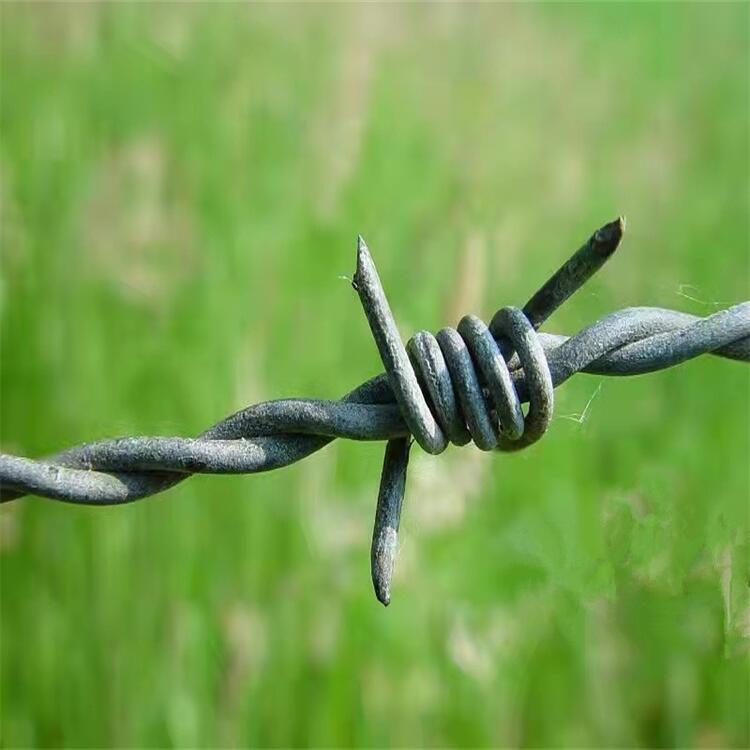
Material and surface coating determine how long barbed wire survives outdoors. Four categories dominate the market. Electro-galvanized wire carries a thin zinc layer of roughly 10–25 g/m², lasts 3–5 years in dry conditions and is the economical choice for temporary fencing. Hot-dip galvanized wire carries a heavier coating of 60–200 g/m², withstands rainfall, UV exposure and coastal humidity for 15–25 years, and is the standard for permanent perimeter installations.
PVC coated wire adds a 0.4–0.7mm polymer layer over the galvanized base, available in green, black, yellow and other colors. It offers extended corrosion protection and, crucially, high visibility — livestock can clearly see the fence and avoid injury. Stainless steel wire (304 or 316 grade) is the premium category for chemical plants, coastal installations and marine facilities, delivering the longest service life at the highest cost. Our factory machines process all four categories, with wire diameter from 1.8mm to 3.8mm and coating parameters adjusted per production run.
Twist structure controls how firmly the barbs are locked and how stable the finished line is. Single twist barbed wire is made by twisting two line wires together with barbs locked between them in one pass. It is lighter, faster to produce and cheaper, but the twist is looser and the wire can untwist under tension or when cut — acceptable for temporary fencing and light agricultural use.
Double twist barbed wire performs a second twisting pass, producing firmer barb locking, higher torsional stability and strong resistance to untwisting under mechanical stress. It is the preferred type for permanent installations, highway barriers and high-security perimeters. Double twist demands a more sophisticated barbed wire making machine with precise second-stage synchronization; our automatic double twist machines hold twist tightness within ±5% across full production runs, verified by a 48-hour continuous test before shipment.
Twist direction is a specification that many first-time exporters overlook, yet it matters in real tenders. Reverse twist (left-hand) barbed wire is twisted counter-clockwise. It is not stronger or weaker than standard wire — the physical difference is barb orientation and how the line behaves during installation.
Some regional markets, particularly the Middle East, Africa and parts of Southeast Asia, explicitly require reverse twist in government procurement because of local post layouts and installation habits, where reverse-oriented barbs align better with the intended fence geometry. For exporters selling into these regions, offering reverse twist can be a decisive competitive advantage. A well-built barbed wire making machine should switch between the two directions by reversing twist-head rotation and adjusting the barb feeding phase — without changing major components. Our machines support both directions with factory-tested changeover procedures, and twist pitch is verified with a dedicated gauge during the 48-hour pre-shipment test.
Barb design sets the deterrent level of the finished product. Two-point barbed wire uses one barb wire wound around the line wires, forming two sharp points at each station, typically spaced every 3–5 inches (76–127mm). It is the economical agricultural standard — effective against livestock and casual intrusion. Four-point barbed wire wraps a second barb wire in the opposite direction at the same station, creating four points per barb location and roughly doubling the deterrent surface.
Four-point wire is widely used for residential security, industrial perimeters and correctional facilities, where barb spacing can be reduced to 2–3 inches for maximum intimidation. Our barbed wire making machines support adjustable barb spacing from 2 to 6 inches and both barb configurations. The cutting angle of every barb is factory-calibrated to balance sharpness with bending strength — the subject of our dedicated article on barb cutting angle — so barbs penetrate well yet resist bending under impact.
5. Classification by Tensile Strength
Wire strength determines how far posts can be spaced and how much material a project needs. Low carbon (mild steel) barbed wire has a tensile strength of roughly 350–500 MPa. It is soft, easy to bend, knot and re-tension — the standard for farm fencing that is frequently tied and repaired, though post spacing must be shorter to prevent sagging.
High tensile barbed wire reaches 600–900 MPa, allowing longer post spacing, lighter weight per kilometer and much better sag resistance. A 2.5mm high tensile line can replace a 3.0mm low carbon line with equal or better holding capacity while cutting material weight by about 30%, reducing freight and post costs. It suits large ranches and long straight perimeter lines. Because the wire is harder and springier, it demands a more powerful barbed wire making machine with reinforced cutting and twisting components — a standard capability of our heavy-duty models, which process high tensile wire up to 3.5mm without sacrificing barb forming precision.
6. Traditional Barbed Wire vs Razor Wire
A common point of confusion is the difference between traditional barbed wire and razor wire (blade barbed wire). Traditional barbed wire uses round wire barbs, is economical and provides deterrent rather than aggressive protection. It stops livestock and casual intrusion, but a determined intruder with gloves and tools can cut or climb it relatively easily.
Razor wire uses sharp steel blade strips, typically 12–22mm wide, wound around the line wire. It presents a substantially higher injury risk and a far stronger psychological deterrent, and it is reserved for prisons, military bases, airports, power stations and other high-value facilities. Razor wire is heavier, more expensive, subject to stricter import regulations in some countries, and requires specialized razor wire making machines rather than standard barbed wire equipment. Choose according to threat level: agriculture and general perimeter security call for traditional barbed wire; critical infrastructure and correctional facilities justify razor wire.

7. Common Specifications and Standards
Understanding common specification language helps buyers communicate precisely with suppliers. Wire diameter is normally expressed in millimeters or BWG gauge — 2.0mm, 2.5mm and 3.0mm are the most common, with 2.5mm the general-purpose standard for both farm and security fencing. Barb spacing is expressed in inches or millimeters: 3" (76mm), 4" (100mm) and 5" (127mm) are standard, with 3" being the most common security choice.
International references include ASTM A121 (standard specification for zinc-coated (galvanized) steel barbed wire), ASTM A817 (PVC-coated steel barbed wire), and ISO 6800 (specification for galvanized barbed wire for fencing). These standards define tensile requirements, coating weight and construction tolerances. When quoting, a complete specification should state wire diameter, coating type and weight, twist type and direction, barb count per station, barb spacing, roll length and tensile grade — for example: "2.5mm hot-dip galvanized 80 g/m², double twist, right-hand, four-point, 3" spacing, 500m roll, high tensile." Our factory supplies wire produced to these standards and can guide buyers through spec sheets for tender submissions.
8. How to Choose the Right Barbed Wire Type
Selection follows a practical five-step sequence. First, define the threat level: temporary farm fencing needs only light electro-galvanized single twist, while permanent security perimeters need hot-dip galvanized or PVC coated double twist. Second, assess the local environment: coastal or high-humidity regions require heavier zinc coating or PVC; chemical and marine settings may justify stainless steel. Third, calculate line length and post budget: long straight runs favor high tensile wire to reduce post count and sagging.
Fourth, match barb configuration to the required deterrence: two-point is sufficient for livestock, four-point adds intimidation for security applications. Finally, check local regulations — some regions restrict razor wire or specify minimum barbed wire standards for agricultural use. When in doubt, send your application details to the manufacturer; our technical team provides free specification recommendations based on 15+ years of barbed wire production experience, and every machine is factory-tested to produce the standard types described in this guide.
Conclusion
Choosing the right barbed wire is a five-dimensional decision. Material and coating determine corrosion resistance and service life; twist structure determines structural stability; twist direction determines regional market acceptance; barb design determines deterrent effect; and tensile strength determines span performance and cost efficiency. The choice between traditional and razor wire then sets the overall security level. Every dimension has a clear trade-off, and the correct selection balances protection, durability and budget for the specific application.
As a professional barbed wire making machine manufacturer, we supply complete production solutions for every major type in this article — galvanized, PVC coated, stainless, single twist, double twist, traditional or reverse direction, two-point and four-point, in low carbon and high tensile grades, to ASTM, ISO and customer specifications. Every machine is backed by factory calibration, a 48-hour continuous run test and lifetime technical support. Whatever type your project requires, the right machine and the right specification guidance will produce barbed wire that performs exactly as intended for years to come.
Type | Key Feature | Typical Specification | Recommended Use |
Electro-galvanized | Thin zinc layer | 10–25 g/m², 3–5 yrs | Temporary fencing, dry areas |
Hot-dip galvanized | Heavy zinc layer | 60–200 g/m², 15–25 yrs | Permanent perimeter fencing |
PVC coated | Color + visibility | 0.4–0.7mm coating | Livestock, high-visibility fencing |
Stainless steel | Maximum corrosion resistance | 304/316 grade | Chemical, coastal, marine |
Single twist | Light, low cost | Standard 2-wire | Agricultural, temporary use |
Double twist | Firm, stable | Second twisting pass | Permanent, high security |
Reverse twist | Left-hand, counter-clockwise | Regional requirement | Middle East, Africa tenders |
Two-point barb | 2 points per station | 3–5 inch spacing | Farm and general fencing |
Four-point barb | 4 points per station | 2–4 inch spacing | Security, correctional |
Low carbon | Soft, easy to work | 350–500 MPa | Frequent tying/repair fencing |
High tensile | Strong, sag-resistant | 600–900 MPa | Ranches, long straight lines |
Razor wire | Blade strips, max deterrence | 12–22mm blades | Prisons, military, airports |
Whats app& Wechat:+8618069820917/+8613675848705/+8615224089430
Tel:+8657185128950
Email: mtc@wiremachinecn.com


